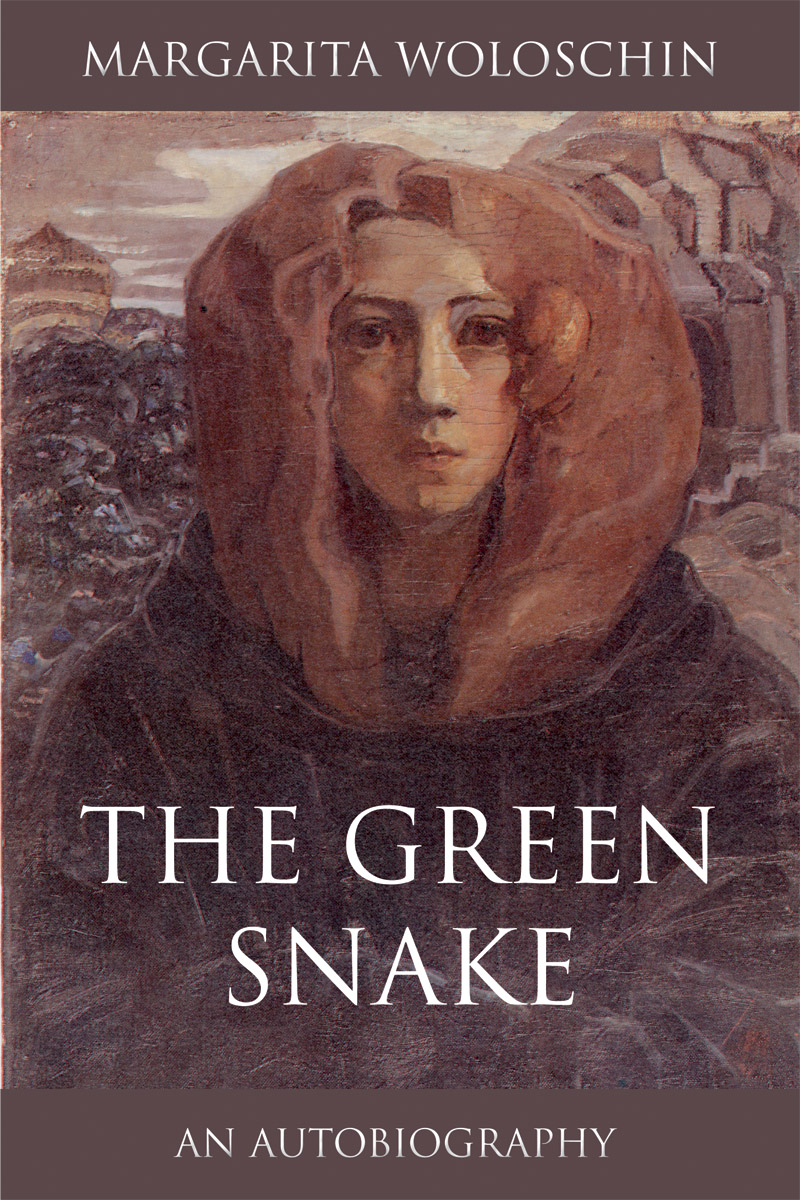
The Green Snake
An Autobiography
Quick Look
- A haunting memoir of tsarist Russia and the Bolshevik Revolution
- This fascinating first-hand account vividly captures the inspirational life of artist Margarita Woloschin
- Interspersed with the artist's personal memories of Leo Tostoy, Max Voloshin and Rudolf Steiner
A first-hand account of a privileged upbringing and the introduction of anthroposophy into turn-of-the-century Russia, and the subsequent revolution.
Description
Told from the perspective of the anthroposophical artist, Margarita Woloschin, this is a first-hand account of her privileged upbringing in Russia and subsequent life. Her vivid recollections of Moscow and rural Russia at the end of the nineteenth century are related in a lyrical, evocative timbre that echoes throughout the book. It records, in lavish detail, Woloschin's meetings with the Russian intellectual elite, including Tolstoy, the impressions they made upon her, her extensive travels throughout Europe and her marriage to the journalist-poet Max Voloshin.
Instrumental in the introduction of anthroposophy into Russia, Woloschin recounts the construction of the original Goetheanum in Dornach, Switzerland, in which she was involved, and its ultimate destruction. The narrative is interspersed with the artist's personal memories and insights of Rudolf Steiner and the struggle for meaning in her own turbulent life.
As the First World War spreads through Europe, she details the harsh deprivations of the Russian Revolution and its effects on her family and friends, which stand in brutal contrast to the earlier bucolic aspect of her testimony.
Set against the extremes of tsarist Russia and the Bolshevik Revolution, this haunting, historical memoir is testament to a fascinating and inspirational life.
Reviews
"One of the great attractions of Woloschin's text is its vivid and detailed evocation of the lost world of a century ago. These memoirs provide a compelling first-hand account of 'the great historical turning point' in which she lived; the condition of Russia in particular during this period is described with great insight and compassion."
-- Zoe Carroll, New View, Autumn 2010.
"This is the first English translation of this remarkable autobiography by the anthroposophical artist Margarita Woloschin, who was instrumental in introducing Anthroposophy into Russia… An absorbing read.'
-- David Lorimer, Scientific and Medical Network Review, Winter 2010
Author
Margarita Woloschin (1882-1973, née Sabashnikova) was born in Moscow and grew up in a well-to-do family with broad cultural links. She studied art in St Petersburg and Paris. From an early age she wanted to find out more about spirituality, and in 1905 met Rudolf Steiner for the first time. In St Petersburg she was part of the Symbolism art movement. In 1906 she married the poet and artist, Maximilian Voloshin.
From 1908 she followed Rudolf Steiner on his lecture tours across Europe, and in 1914 she went to Dornach, Switzerland, where she worked the building of the first Goetheanum. In 1917 she returned to her native country, now in the midst of a revolution.
From 1924 until her death in 1973 she lived in Stuttgart, Germany, where she was at her most creative artistically, painting portraits as well as altar pictures.