The Incarnation of Christ: A Spiritual Embryology
by Floris Books • 22 May 2026 • Extract, Religion • 0 Comments
In a series of lectures that he gave on the incarnation of Christ, Rudolf Steiner compared the period of Christ’s life between his baptism and crucifixion to that of prenatal human development. But what did he mean by this? And how can an understanding of human embryology help us to understand the incarnation of Christ?
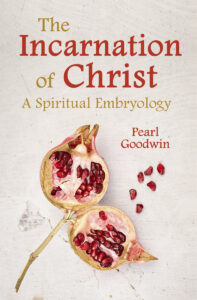
“A remarkable treatise. Lucid and well informed.” – New View
Retired Christian Community priest Pearl Goodwin is uniquely qualified as a student of both embryology and the work of Rudolf Steiner to expand on this intriguing insight. In The Incarnation of Christ, Goodwin outlines the stages of a spiritual embryology. She goes beyond the crucifixion to argue that the creation of a physical human body is mirrored in the creation of Christ’s resurrection body.
In this extract from The Incarnation of Christ, Pearl explains her purpose in exploring this fascinating subject.
Introduction
This study is an attempt to gain some understanding of the spiritual conception through the phenomena of human conception. Both of these can be regarded as a step in incarnation, but taking place in different realms.
The word ‘incarnation’ is the anchor point of Rudolf Steiner’s Christology. It comes from the Latin in carne, meaning, to enter flesh. This immediately tells us of a dynamic that is not part of modern thinking – that human beings, indeed all sentient beings, consist of interweaving parts that are separate from each other and must be brought together by this dynamic of ‘incarnation’. There is a separation of conscious and unconscious, of body and soul/spirit. How they come together is the process of incarnation.
This is fundamental to all human life. Falling asleep at night is not simply the brain shutting down. It is something leaving the brain that allows it to shut down. That ‘something’, our awake consciousness is then able to return to its own home in the spirit and return again in the morning, renewed and refreshed. This is called ‘waking up’ and is the dynamic of incarnation on its smallest scale, the rhythm of day and night.
“There is a separation of conscious and unconscious, of body and soul/spirit. How they come together is the process of incarnation. This is fundamental to all human life.”
How our particular consciousness comes to be in our particular body belongs to the next level of incarnation, the rhythm of life and death. This is the content of an anthroposophically inspired embryology, which is treated more fully in this study, unfolding how our conscious being unites with the developing embryo, having had its own biography in the spiritual world between death and
rebirth.
Highest of all is the incarnation of the Christ spirit into the earthly body of Jesus of Nazareth.
All levels of incarnation need preparation. At the smallest level, how we prepare for the night can affect how we wake in the morning. At the level of life and death, what we carry as karma from previous lives will have an effect on developmental processes as it interweaves with what is given by earthly heredity.
The incarnation of Christ needed a unique preparation. A spirit, stronger and purer than any of us, chose to come to the earth, not out of karmic necessity but out of love for humanity and compassion for its suffering. This spirit could not have entered directly into the ordinary embryological process, for its power would have been like a destroying fire. There was no ‘Christ child’ as is popularly thought. Instead, other real children had to be prepared so that Christ could incarnate into a human body. Who then was able to take on the body into which Christ was to incarnate, a body that would be able to resurrect? This also had to be carefully prepared. What was needed was a body of great purity, unimpaired by any karma, and also a consciousness that held all that could be learned on the earth. This needed two human beings, with different kinds of spiritual and earthly biographies. The Matthew and Luke Gospels tell the stories of these two individuals, both called Jesus. Their stories will unfold in this study.
“The incarnation of Christ needed a unique preparation. A spirit, stronger and purer than any of us, chose to come to the earth, not out of karmic necessity but out of love for humanity.”
About the author

Pearl Goodwin studied embryology and genetics at the University of Edinburgh, Scotland and later worked at MIT in the United States. In 1977 she was ordained as a priest of The Christian Community, and for many years taught embryology at The Christian Community seminary in Stuttgart, Germany. She is now retired and lives in Forest Row, UK.
You may also be interested in…
The Incarnation: Finding Our True Self Through Christ by Tom Ravetz
The Incarnation, God becoming human in the person of Jesus of Nazareth, is a central mystery of Christianity. This inspiring book examines the theology of the Incarnation, and traces the history of human thinking about it.
Tom Ravetz discusses Rudolf Steiner’s unique insights into the Incarnation and shows how the process of incarnation is reflected in each one of us.
Connect with us
Keep up to date on new releases, receive exclusive discounts and a free book with every order placed on our website when you join our mailing list.


